Black Truffle Pieces: Aroma Without the Shape
Truffle pieces are black truffle, Tuber melanosporum, that broke while being lifted from the ground or cleaned.
A truffle that breaks as it is lifted keeps its aroma. What it loses is the shape, and with the shape the price.
That broken truffle is sound truffle, and it is what ships in a food lot: ready to use, for anything grated, chopped or cooked in.
Pieces are not off-grade. Off-grade — sorting offcuts and damaged or rotten truffle — sits in the same price band, but it is not kitchen product and it does not go into a food order.
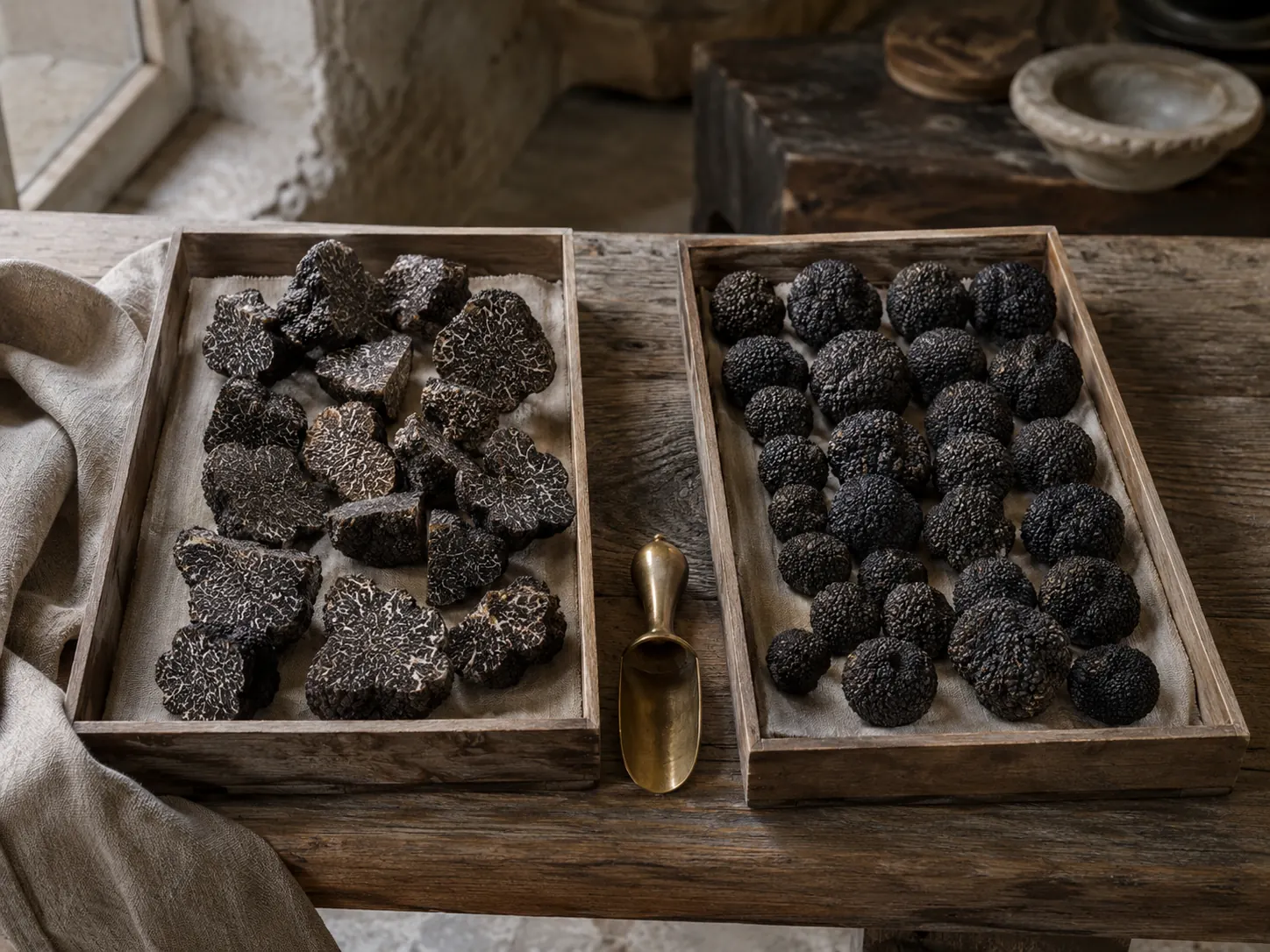
How a black truffle becomes a piece
The dog has to find it without scratching it, and the person lifting it has to get it out whole. Both things fail sometimes.
A grower describes the two usual cases: a shallow one that the dog catches with a paw, and a corner taken off by the knife during the lift. The pointed, irregular lower grades add a third, breaking while they are cleaned.
Why pieces cost a fraction of a whole one
The grower gives one example of what a break does to the price: an Extra piece at a market reference of 1,200 euros per kilo, split in two by the knife, drops to 150. One eighth of the price, for a truffle that lost its shape and nothing else.
What kitchens and processors use pieces for
A restaurant puts an Extra piece on the counter and cooks with lower grades, because in the pan the shape is invisible. Pieces take that logic one step further.
- Sauces, stuffings and butters, where it is chopped or grated in.
- Prepared products and preserves, which are usually made from broken product.
- Any dish where it is tasted but not seen whole.
Pieces and off-grade: what ships
Both land in the same price band, which is where the confusion starts. They are two different things.
Pieces are sound black truffles that broke while being lifted, sorted or moved. They are what is sold to be eaten, and they leave ready to use.
Off-grade is what the sorting leaves behind: offcuts, and truffle that is damaged or rotten. It is not kitchen product and it does not go into a food lot, whatever the kilo happens to be worth that week.
Where off-grade truffle goes
Nothing is thrown away: every grade has a destination, and the destination of off-grade is not a plate.
Where the spore quality is good, it is used to make nests and spore inputs in truffle orchards. It also goes to nurseries, to mycorrhize plants and to prepare spore substrates.
That work is done by specialist firms in the sector. Processing for consumption is the packers’ side of the trade.
Pieces are not peelings
Pieces are broken black truffles, still recognisable as such, with flesh and skin. Peelings are the trimmings left after cleaning whole ones, with no shape at all.
If the finished product should show a fragment, ask for pieces. If it is blended, peelings are the cheaper raw material.
Ordering black truffle pieces by the kilo
Price depends on whether you buy ten grams or a hundred kilos. Pieces are quoted by volume, against what the current harvest has produced.
Tell us the quantity, the use and the destination. Fresh pieces exist from December to April; for the rest of the year, ask about the frozen format.
Related trade pages:
- Black Truffle Wholesale — Direct from the Grower
- Black Truffle Peelings for the Trade
- Frozen Black Truffles for the Trade
- Black Truffle Price per Kilo
Do truffle pieces smell the same as a whole black truffle?
A piece that breaks while being lifted loses its shape and most of its price, not its aroma. That sound broken truffle is what ships, ready to use.
Are pieces and off-grade the same thing?
No. Pieces are sound truffle that broke, and they are what is sold to be eaten. Off-grade — sorting offcuts and damaged or rotten truffle — shares the price band but not the destination: in the trade it goes to nests and spore inputs in truffle orchards where the spore quality allows, and to nurseries, to mycorrhize plants and prepare spore substrates.
What size are the pieces?
From a corner broken off a whole one to a piece split in half. Size varies with the harvest week; ask for the current lot with the quotation.
Request a trade quotation for pieces
Send the volume, the intended use and the destination. A quotation against the current harvest, and what the lot actually contains, comes back before you commit.
Request trade pricing