Preserved Black Truffle: Peelings, Pieces & Frozen
Preserved black truffle ships as ordinary goods and keeps when the fresh season is over. Same Tuber melanosporum, graded at origin in Teruel, in six trade formats.
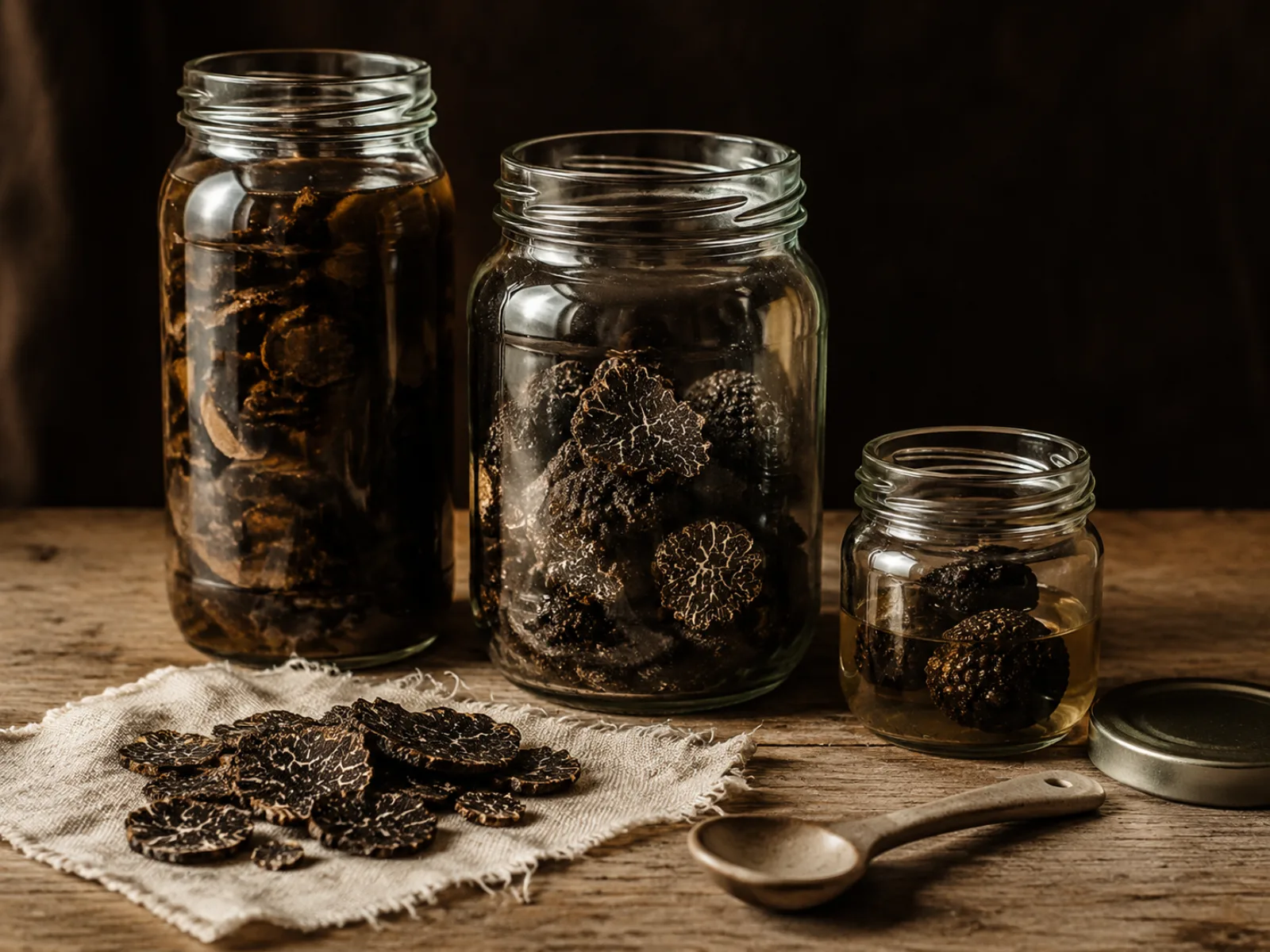
- No cold chain required
- Available outside the winter season
- Same species, graded at origin
- Origin: Teruel, Spain
Why preserved black truffle exists
Preserved formats are not a product line invented in a marketing meeting. They are what happens when the wholesale market drops: prices fall, selling stops being worth it to the grower, and the harvest has to keep instead of moving.
Nothing is wasted, in the grower’s words: every grade has a destination. Fresh comes first — a perishable, seasonal product is best used and moved fresh — and what does not go out fresh goes to the packers.
The formats themselves solve three trading problems at once. They are stable, they ship as ordinary goods, they do not shrink in transit and they are there when the fresh season is not.
They also answer a supply problem. Not every piece that comes out of the ground is a well-shaped whole one. A truffle that breaks on the way out keeps its aroma and loses its shape, and with it most of its price; peeling trimmings have no shape to begin with. Preserving them turns that difference from a loss into a product.
The six formats, and what each one is for
| Peelings | Trimmings from peeling whole pieces. For oils, butters, sauces and fillings. Strong aroma, no shape. |
|---|---|
| Pieces | Broken black truffles of good maturity, in brine or sterilised. For sauces, stuffings and prepared dishes. |
| Whole, canned | Whole graded black truffles, sterilised. The presentation format where the piece is seen. |
| Frozen | Frozen whole or in pieces. Closest to fresh in aroma; needs freezer storage but no timed cold chain. |
| Freeze-dried | Lightest and longest-keeping format. For seasonings, blends and dry preparations. |
| Sliced | Pre-sliced in preserve, for service where plating speed matters. |
Yields and drained weights differ substantially between these formats. Ask for the specification sheet rather than comparing prices per unit. Freezing is the one the grower associates with eating the product later: frozen in season, it can be sold and used through the rest of the year. Drying is the least used technique of the lot, and slicing and drying is done in the sector above all for a different purpose — spore work in plantations.
Minimum order, unit sizes and shelf life
| Minimum order | 12 units per format |
|---|---|
| Who makes them | Packing plants. The plantation supplies the truffle; processing for consumption is done by the packers |
| Packaging and unit sizes | 25 g, 30 g and 50 g jars; 12 units per case |
| Shelf life | 36 months unopened for preserves; 6 months frozen at −18 °C |
| Private label | Yes, from 300 units per format |
| Availability | All year. Production runs in season, stock ships out of season. |
Food safety, labelling and documentation
Preserved production is a different regulatory animal from selling fresh: it needs a registered facility, and retail listings usually require third-party certification.
That is why these formats are made by packing plants and not on the plantation. The registration and the certification that apply to a given format are the packer’s, and they come with the specification sheet for that run.
Labels are supplied in Spanish, English, German and French, with nutritional analysis on request.
Fresh black truffle, in season
From December to March the same harvest ships fresh, graded Extra, First, Second and pieces, by the kilo, with the cold inside the box.
What buyers ask about preserved formats
Do preserved formats taste like fresh black truffle?
Not identically. Sterilisation costs some of the volatile aroma, which is why preserved product is used in cooked and blended preparations rather than shaved raw. Frozen stays closest to fresh; freeze-dried keeps longest and concentrates differently.
Is the black truffle in these formats lower quality?
It is lower grade by appearance, not by species or aroma. Pieces and peelings come from the same harvest of Tuber melanosporum as the whole graded product. What is sold cheaper is shape.
Is truffle oil part of this range?
No. Trufaria does not sell truffle oil: most of what is sold under that name contains no truffle at all, only synthetic aroma compounds.
Can you supply summer truffle in preserved formats?
Yes, Tuber aestivum in peelings and pieces. Its season runs from spring to autumn, and the grower works it only occasionally. It is a different species with a milder aroma and a considerably lower price, and it is labelled as such.
Request specifications and a quotation
Tell us the format, the unit size and the annual volume you are planning. Specification sheets and samples are available for trade enquiries.