Inoculated Truffle Trees: How Black Truffle Mycorrhiza Works
Inoculated truffle trees are host trees whose roots have been colonised in the nursery by the black truffle fungus, Tuber melanosporum.
Without that inoculation a tree is only a tree. With it, root and fungus form a partnership that can produce for decades.
This page explains what the partnership is and how to check that a plant really has it.
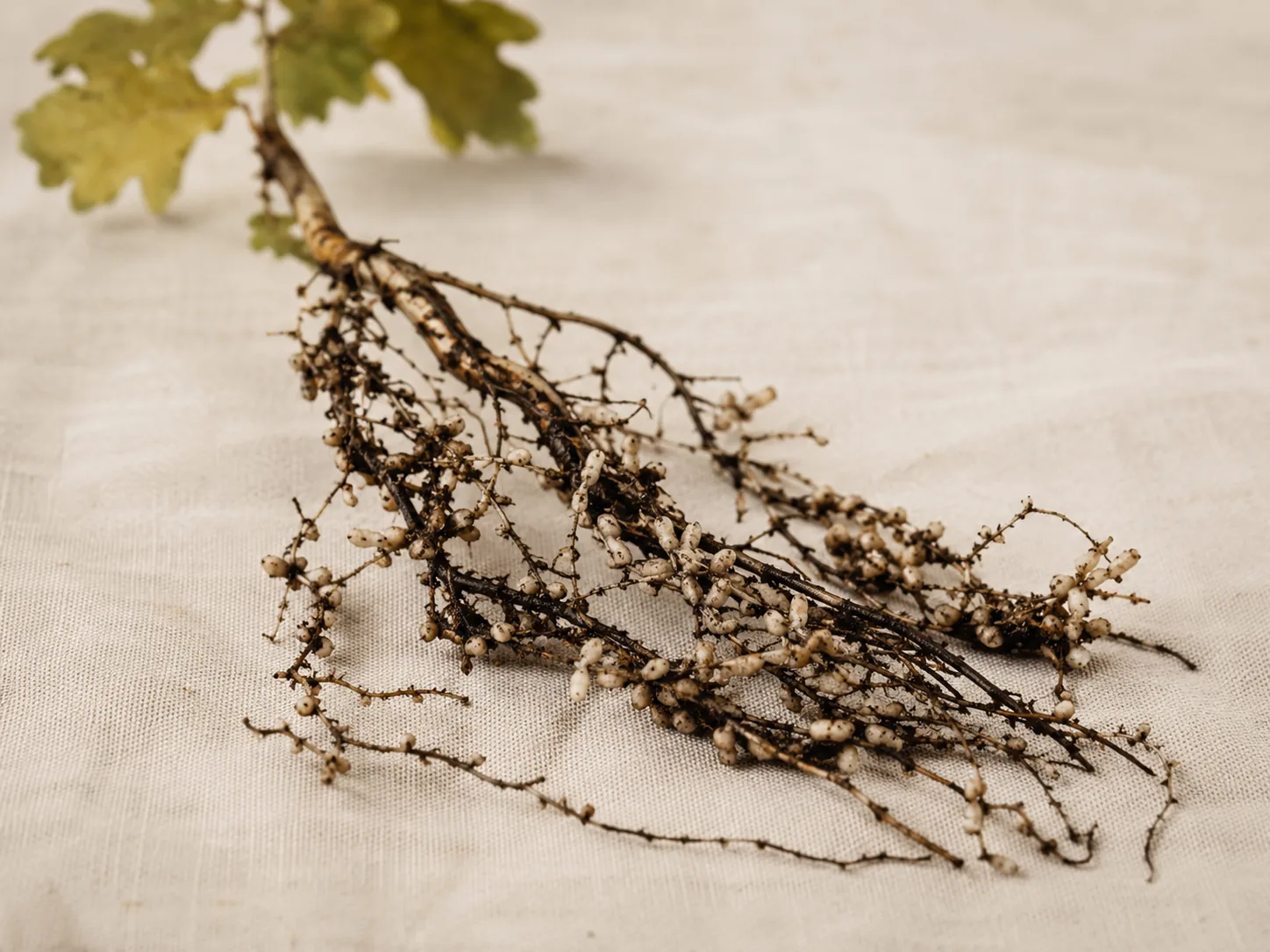
The symbiosis an inoculated tree carries
The fungus and the plant live in symbiosis: each feeds the other. The grower adds the part that matters for a plantation: if the plant lacks food, it will not give any to the fungus.
A harvest is a consequence of a healthy tree. Anything that weakens the tree, from poor soil to pests, reaches the fungus a step later.
Why a weak tree stops giving black truffle
The grower gives an everyday example: leaf galls. The insect eats some of the leaf, the tree has less surface for photosynthesis, it makes less food for itself, and so there is less for the fungus.
That chain is why the inoculation is a precondition and not a guarantee. It is also why the plant’s first years decide more than the year it was bought.
How the inoculation is proved: the analysis you commission
The check that decides a purchase is not the nursery’s own. The buyer sends plants to an outside laboratory that specialises in truffle growing, and the grower does it on every batch, every time.
Truffle growing is a hermetic sector, in his word, so the report is what replaces trust. It comes back in six parts.
- The percentage of roots colonised by the truffle fungus.
- The total number of mycorrhizal root tips.
- The percentage of roots colonised by other, contaminating fungi.
- Which contaminating species are present, and how dangerous each one is.
- The morphological and health quality of the shoot and of the root system.
- Conclusions and recommendations.
What the numbers have to say
Current protocols put the minimum at around 33 per cent Tuber melanosporum, averaged over the plants analysed. The ideal band is 55 to 70 per cent: at that level you have a good plant.
Two conditions travel with the percentage. Contaminating mycorrhizas should be few, and there should be none at all from other Tuber species — one of them, Tuber brumale, can take a plot over.
The analysis costs around 65 euros per plant analysed, with a minimum of five, and the number rises with the order: for a plantation of a thousand plants, about twelve are analysed. Spread across the order it is a small line, and it is the only one that tells you what you actually bought.
What happens if the batch does not pass
This is the objection every buyer has, and it has an answer.
The grower’s arrangement with his nurseries is that when the analysis certifies a batch is not fit to plant, the whole batch goes back with the report and is replaced with an equivalent one that does pass the control, at no additional cost.
That agreement is closed before buying, not after the result arrives. Confirm as well that the laboratory will stand behind its findings whatever they turn out to be.
Forest quality: the other half of the plant
Mycorrhiza is half of what you are paying for. The other half is that this is a forest tree, and it has to be a sound one.
Spanish nursery stock is governed by Royal Decree 289/2003: no wounds, no multiple callusing, a formed root system, no signs of disease or poor condition, no imbalance between shoot and root, and dimensions appropriate to its age.
The grower sums it up as a hardened plant — healthy, balanced, free of deformities, and able to establish itself in the field.
The four ways a plantation fails
Quality control on the plant exists to avoid four outcomes, and the grower lists them in order.
- Plantations that never form a brûlé, the bare ring under the tree, and never produce.
- Plantations that form the brûlé and still produce nothing.
- Plantations that produce another species instead — Tuber brumale, Tuber aestivum.
- Plants that simply die.
Ordering inoculated truffle trees
The density the grower plants at is 300 trees per hectare, so the surface fixes the number of plants. Order well ahead of the planting season: inoculated stock is raised to order.
Tell us the surface and the country. Live plants are subject to plant-health rules that differ by destination, so delivery is confirmed at the time of ordering, and the price comes with the quotation.
Related pages:
- Truffle Trees for Black Truffle (Tuber melanosporum)
- Truffle Trees for Sale: Black Truffle Plants from Spain
- Truffle Seedlings for a Black Truffle Plantation
- How to Grow Black Truffles
- Tuber melanosporum: the Black Truffle
What does inoculated mean for a truffle tree?
That the black truffle fungus, Tuber melanosporum, has been established on the roots in the nursery. Tree and fungus then feed each other, which is what makes a harvest possible years later.
Does the inoculation guarantee a harvest?
No. It is the precondition. The grower is clear that plantations fail when something after planting was done wrong. Soil, water, pruning and pests decide the rest.
What level of mycorrhization should I ask for?
Protocols set a minimum of around 33 per cent Tuber melanosporum, with 55 to 70 per cent as the ideal band, few contaminating mycorrhizas and none at all from other Tuber species. The figure comes from an analysis the buyer commissions, not from the nursery’s own claim.
What does the analysis cost?
Around 65 euros per plant analysed, with a minimum of five plants. For a plantation of a thousand, about twelve are analysed, and the cost is spread over the whole order.
Ask for a quotation for inoculated trees
Send the surface you plan to plant and the country. You get the number of plants, the price and whether delivery to your destination is possible before committing.
Ask for a quotation