How to Grow Black Truffles
How to grow black truffles has a plain answer and a long timeline: you plant a tree that already carries the fungus on its roots, and you look after that tree for years before anything comes out of the ground.
This article follows what a grower in Spain does, in the order he does it, with his own numbers.
The tone is his: the black truffle is beautiful, but the aim is kilos.
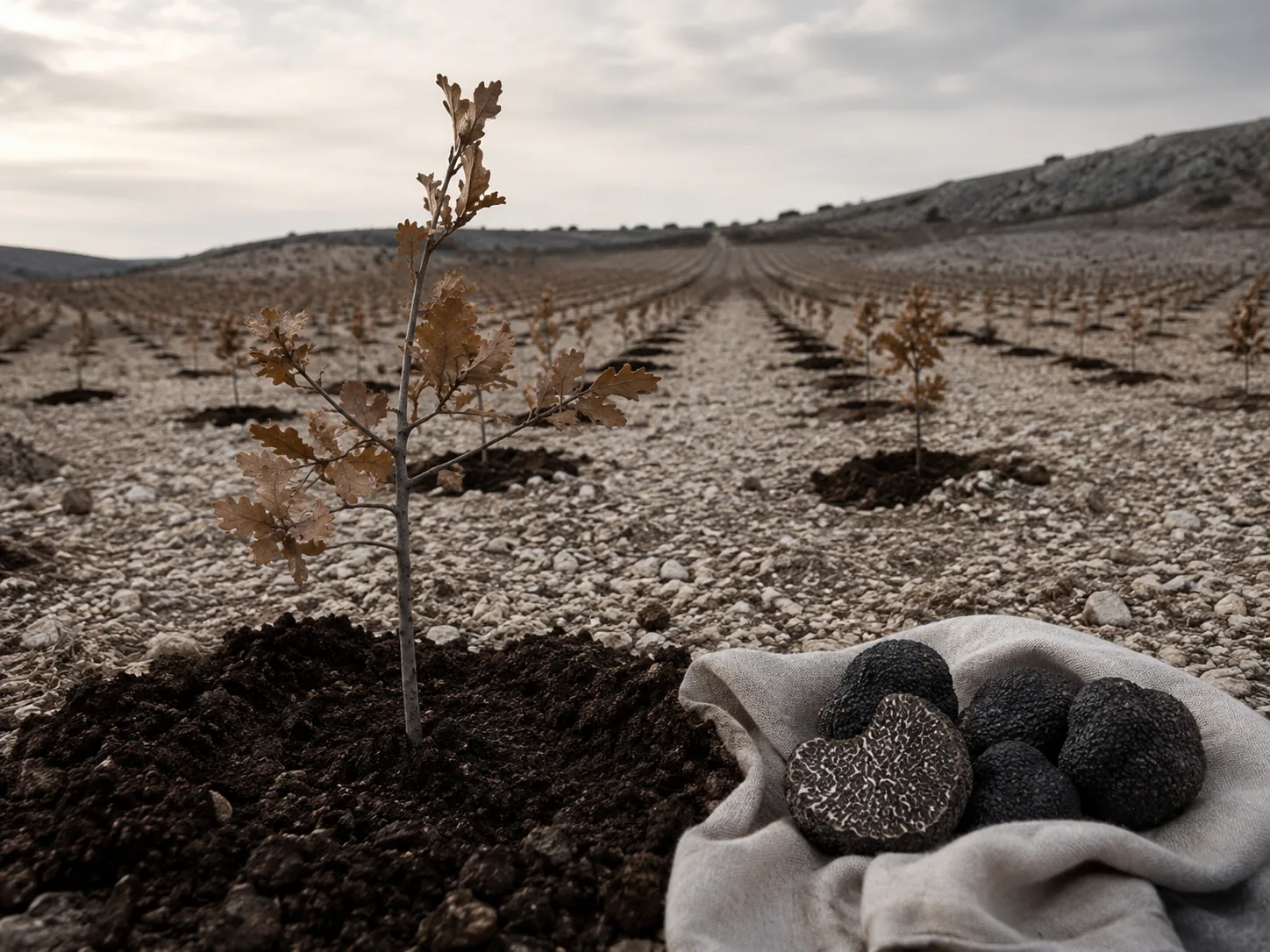
Start with the tree, not the fungus
Black truffle, Tuber melanosporum, is not sown like a vegetable. It lives on the roots of a host tree, and the two feed each other in a symbiosis: if the tree lacks food, the grower says, it will not give any to the fungus.
So growing it means buying an inoculated tree and then keeping that tree healthy. Everything else follows from those two decisions.
The inoculation is not taken on trust either. The buyer sends plants from the batch to an outside laboratory, which reports the share of roots colonised by black truffle and by anything else. Protocols ask for a minimum of about 33 per cent Tuber melanosporum, and no mycorrhizas from other Tuber species at all.
How many trees, and where they can grow
The grower plants 300 trees per hectare; for a forty-hectare project, his own arithmetic was about 12,000 plants.
Where they can grow has widened. Twenty years ago, he says, planting black truffle in La Mancha was unthinkable; today there are producing plantations there, including one he saw with twelve years of age. In that soil it forms at about 50 centimetres deep and takes more work to lift.
His answer to “can I plant here?” is cautious: he would say yes, but it carries a lot of complexity. The soil is analysed and, more importantly, interpreted before anything goes in.
When the trees go in the ground
Autumn, and the grower gives the months: October and November. Planted then, the tree has winter and spring to develop roots and does not meet its first summer with almost none.
Spring is the other option, and it is widely used, but he only recommends it where springs and summers are cool and damp. Elsewhere the young tree suffers the dry spells and needs support watering through the first year. What nobody should do is plant in the depth of winter.
On the day itself, look for ground in good tilth — neither waterlogged nor dry — a spell of stable temperatures, and a run of rain due shortly afterwards. That last detail saves the first waterings.
Water: the part most people get wrong
Irrigation is on the grower’s list of essential works, and he notes that only a handful of companies in Spain specialise in irrigation for black truffle. Most people call a plumber they know instead.
The reference system is micro-sprinkler irrigation, with a published dose of 20 to 25 litres per square metre every 15 to 20 days from June to August, less whatever rain has fallen. In the first years the water only supports rooting; productive irrigation matters from year five or six. Too much does as much harm as too little.
The timeline, year by year
The grower gives the years as they are, and calls the whole thing a very long-term investment.
- Years 5–6: first truffles, token amounts.
- Years 8–10: commercial production.
- Years 10–12: the plantation starts to earn.
- Years 12–18: peak production.
- Up to year 30: productive life.
What a hectare really yields
The grower designs his plantations to reach the highest yield possible, with 200 to 250 kilos per hectare as the design target. That is a target, not a promise.
What he calls ideal in practice is 50 kilos per hectare, and he is clear that anything from 20 kilos upward is already a good result. Anyone promising more than that is selling something other than black truffle.
Why some plantations never produce
The grower says the sector lacks professionalisation: people take a plot and put the plants in any old way, and some plantations produce nothing because a detail was missed.
The detail is usually one of the things above: the plant, the soil, the water, or the pruning. Growing black truffle is not difficult to describe. It is difficult to do without skipping a step.
Where this article leads:
- Truffle Trees for Black Truffle (Tuber melanosporum)
- Inoculated Truffle Trees: How Black Truffle Mycorrhiza Works
- Black Truffle Farming: What a Plantation Costs and Yields
- Black Truffle Orchard: Planting, Pruning and Pests
How long does it take to grow black truffles?
First truffles at five or six years in token amounts, commercial production at eight to ten, and the plantation starts to earn at ten to twelve years, according to the grower.
When is the best time to plant?
Autumn, specifically October and November, so the tree roots through winter and spring. Spring planting is only advisable where springs and summers are cool and damp, and it needs support watering the first year. Not in mid-winter.
Can I grow black truffles in my garden?
The grower’s answer to “can I plant here?” is that he would say yes, but it carries a lot of complexity. The soil has to be analysed and interpreted first, and the tree has to be a properly inoculated one.
Ready to start with the tree?
Send the surface you plan to plant and the country. You get the number of plants, the price and whether delivery is possible before committing.
Ask for a quotation