Black Truffle Orchard: Planting, Pruning and Pests
A black truffle orchard is a plantation of host trees inoculated with Tuber melanosporum, and what happens above ground decides what happens below it.
This article follows the grower’s year in the orchard: how densely he plants, what he does in spring and autumn, who installs the water and why a chewed leaf matters.
It is written for people who already have trees in the ground, or are about to.
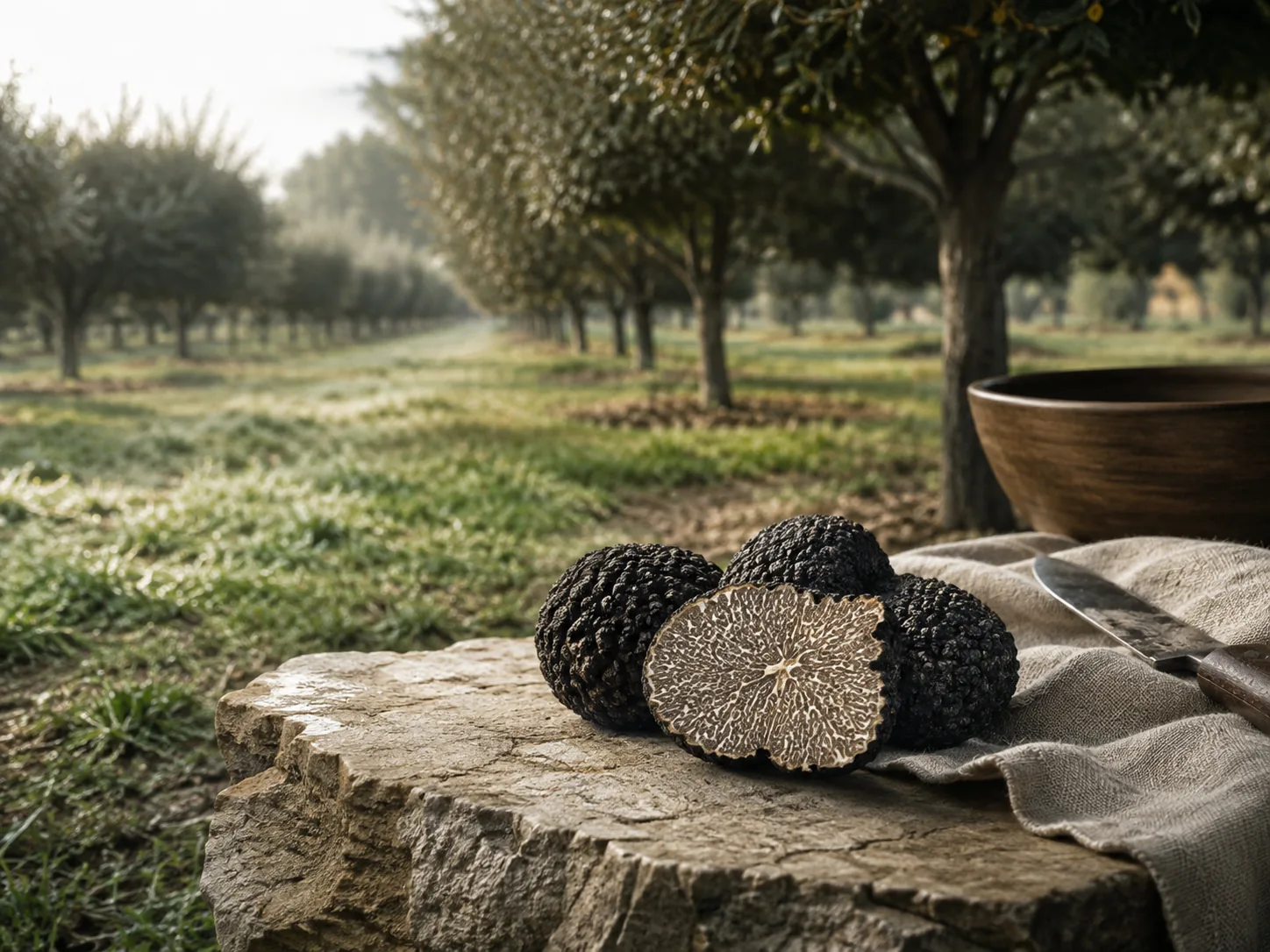
Layout: 300 trees per hectare
The grower plants 300 trees per hectare. He gives no spacing pattern, only the density, and he is explicit about why: there is no ideal planting layout.
The layout follows six things — the host tree, the water you can supply, the aspect and sunlight, the surface available, the investment and the return you are after, and, where a subsidy pays for part of it, whatever the decree imposes. Small plots are planted tight, as is common in France, to use the ground and bring production forward; the price of that is more shade and more water.
Some distances are fixed for you: minimum setbacks from neighbouring land, roads and tracks, other infrastructure, and watercourses, where the river authority sets the figure. Leave room as well for maintenance, for harvesting and for machinery to pass.
Everything downstream, from the plant order to the irrigation design, is sized from that density.
The calendar: pruning in spring, weeding in autumn
In the grower’s year, pruning is a spring job and weeding is an autumn job. In one recent year, he notes, everything fell in spring and the weeding was left for autumn.
Those are the two fixed points. The rest of the calendar is irrigation in summer and harvest in winter.
- Spring: pruning.
- Summer: irrigation.
- Autumn: weeding.
- Winter, December to April: harvest.
Pruning a truffle tree is not ordinary pruning
The grower does the pruning himself, and explains why: you have to know which branch, when, where and why. It is not what a gardener does to a hedge.
One detail he insists on: the shears are disinfected between trees. Whoever helps him is put to that job first.
Irrigation: five companies in Spain, and everyone’s plumber
Irrigation for a black truffle orchard is not irrigation for tomatoes. The grower counts about five companies in Spain that specialise in installing it.
What usually happens instead, in his telling, is that the owner calls an uncle who is a plumber, or a friend from the bar, or a cousin. That is the objection and the argument in one sentence.
Pests: what a leaf gall does underground
A client once sent the grower a photo of galls on a plant. He could not identify the insect from the picture, and neither could the pest specialist he consulted: there are 149 species in the Iberian peninsula that make identical galls. Until you see the insect, you do not know.
The damage from galls is mild in itself. The insect eats some leaf, the tree has less surface for photosynthesis, it makes less food, and so there is less for the fungus. The black truffle is fed last.
Harvest: lifting without breaking
The orchard’s value is decided in its last metre. The dog has to find the piece without scratching it, and the person lifting it has to get it out whole.
The grower has seen it go wrong with clients in the plot: a knife catches a corner, or the dog reaches a shallow one first, and it comes out split. A split piece is worth a fraction of a whole one.
Where this article leads:
- Truffle Trees for Black Truffle (Tuber melanosporum)
- Truffle Seedlings for a Black Truffle Plantation
- How to Grow Black Truffles
- Black Truffle Farming: What a Plantation Costs and Yields
How far apart are trees planted in a black truffle orchard?
The grower gives a density, 300 trees per hectare, rather than a spacing pattern. In his words there is no ideal layout: it depends on the host tree, the water, the aspect, the surface, the investment and any subsidy conditions, and on the minimum distances the law requires from neighbouring land, roads and watercourses.
Do black truffle orchards need irrigation?
Yes. Installing irrigation is on the grower’s list of essential works, and he notes that only around five companies in Spain specialise in irrigation for these plantations.
Start the orchard with the right plant
Send the surface and the country. You get the number of plants, the price and whether delivery is possible before committing.
Ask for a quotation